

It’s no surprise that AI is changing how people access information. Before, if you wanted to have restaurant recommendations, you would turn to Google to find the best restaurant in your area. Today, you may start by asking ChatGPT or TikTok. Search engines are no longer the only go-to, so brands need to appear in AI responses and not only Google if they want to stay relevant.
GEO or Generative engine optimization, does just that. GEO prepares your content to increase the odds AI chatbots like Gemini, ChatGPT or Google AI Summaries cite you in their response.
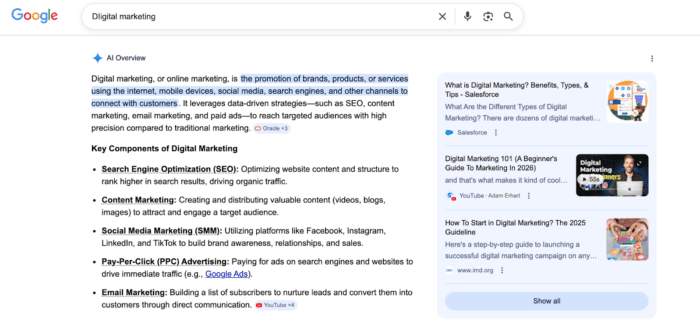
What Is The difference Between GEO And SEO?
Many consider GEO as the natural evolution of SEO, but what really differentiates them?
In SEO, the primary goal is to rank the highest in a specific search result. Search visibility across Google and other engines is determined by factors such as content quality, site architecture, backlinks, technical optimizations, and many more.
As for GEO, the goal is essentially to become the primary source cited in AI answers and increase visibility in chatbot responses. There is no “ranking” in AI. What matters is whether the AI mentions and recommends you consistently, and that comes from authority, consistency across trusted sources, and content that actually answers questions.
SEO and GEO both want to connect your content with users; what differs is how they deliver it.
What Does It Mean For Your Strategy?
SEO isn’t dead, it just has a new teammate.
Visibility is no longer tied to a single touchpoint. A user might first encounter a recommendation through an AI tool, then validate it on Google, and only afterward visit a website. In many cases, the initial trigger, the moment where interest is created, is invisible in traditional analytics.
This shift means we’re no longer only optimizing for clicks, we’re also optimizing for inclusion. Being cited, summarized, or recommended by AI systems becomes a key driver of awareness and consideration. Because these systems largely rely on existing content ecosystems to generate answers, our digital presence must be strong, consistent, and easy to interpret across multiple sources.
GEO also introduces a new layer of brand influence. The way your brand is described across the web directly shapes how AI represents you. In other words, we’re not just managing what we publish, but also how our brand is understood and repeated by machines.
Ultimately, GEO pushes us to think more holistically: not just about traffic, but about perception, discoverability, and trust at the very top of the funnel.
6 GEO Best Practices
The good news is that GEO doesn’t require starting from scratch; it builds on strong SEO foundations. But it does require a shift in execution and priorities.
1. Create Content That Answers Real, Specific Questions
AI-driven discovery is fueled by detailed, intent-rich queries. Users are asking for curated recommendations based on context, constraints, and preferences. Your content should reflect this by addressing concrete use cases, scenarios, and needs. And, in a GEO context, having a deep understanding of your audience is becoming more essential than ever.
2. Prioritize Clarity And Structure
AI systems favour content that is easy to parse and summarize. Clear headings, logical organization, concise explanations, and well-formatted elements (like lists or tables) all increase the likelihood of being reused in generated answers.
3. Strengthen Credibility And Consistency
Reliable, accurate, and up-to-date information is essential. But beyond that, consistency across channels matters. Repeating key messages, maintaining alignment between sources, and reinforcing the same positioning helps AI systems associate your brand with specific attributes and increases your chances of being cited.
4. Manage Your Broader Content Ecosystem
Your visibility in GEO is not limited to your website. Media mentions, reviews, social content, and third-party platforms all contribute to how your brand is perceived and described. Monitoring and shaping this ecosystem helps reduce the risk of misrepresentation and strengthens your overall presence.
5. Think Beyond Last-click Attribution
Because AI often plays a role earlier in the journey, its impact may not be visible in traditional analytics. This requires a shift in how we evaluate performance, looking beyond direct traffic and considering influence on awareness, preference, and demand generation.
6. Technical Foundations Matter
Technical elements are essential in GEO because they allow AI systems to access and properly understand your content. In simple terms, your website needs to be fast, easy to read, and accessible; otherwise, it may simply be ignored. Clear structure, consistent information, and basic technical optimizations help AI recognize your site as a reliable source. In short, even great content won’t perform well without strong technical foundations.
Need a partner to bring it all together? Contact us.
Subscribe to The Shift Factor
Our newsletter keeps you in the know on marketing’s biggest shifts and real examples of brands adapting.
ABOUT THE AUTHOR

Dimitri Lemieux
Dimitri is an SEO Strategist at Bloom. He is passionate about digital strategy, data-driven optimization, and helping brands grow their online visibility through thoughtful and sustainable SEO practices.


Share this: